11 noviembre, 2026, Por: CCMSS
PRESS RELEASE
At the 31st United Nations Climate Change Conference (COP31) in Türkiye, the Mexican Civil Council for Sustainable Forestry (CCMSS) and Foundation PRISMA (Regional Research Program on Development and the Environment) are launching a policy brief that highlights Mesoamerica’s contributions to global efforts to halt deforestation. Experiences from across the region offer important lessons that can guide public policies and investments capable of sustaining forest conservation over the long term.
Mesoamerica is a strategic region for global conservation, harboring between 7% and 8% of the world’s biodiversity. Approximately 65% of its forests are under some form of collective ownership or use by Indigenous Peoples, Afro-descendant Peoples, and Local Communities (IPAPLC).
The relationship between forests and systems of collective ownership and organization makes Mesoamerica an important source of lessons for efforts to halt deforestation, which accounts for approximately 11% of global greenhouse gas emissions.
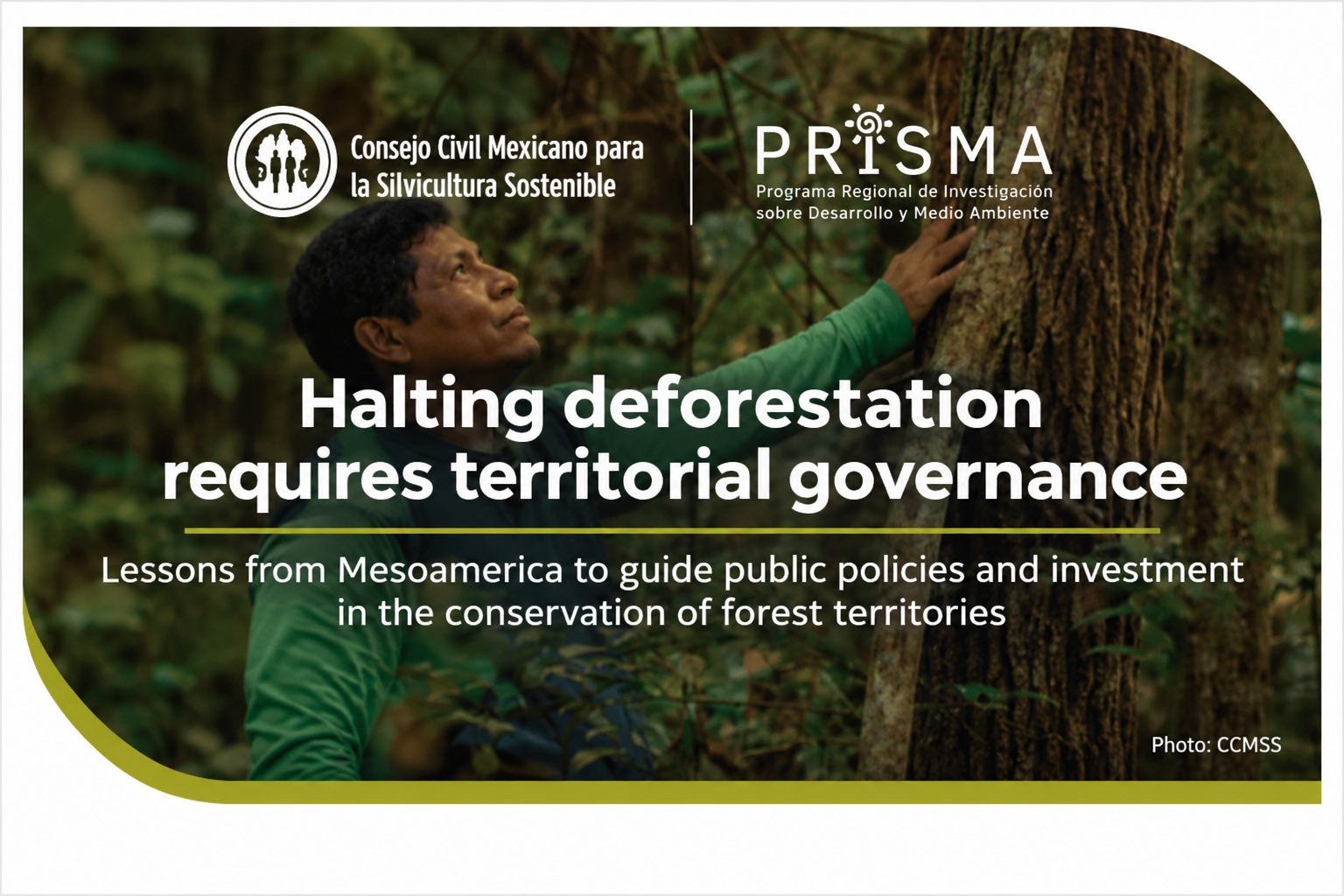
The policy brief, “Halting Deforestation Requires Territorial Governance: Lessons from Mesoamerica to Guide Public Policies and Investment in the Conservation of ForestTerritories,” identifies four key lessons from the region for conserving forest territories and their ecological, social, and cultural functions.
These lessons range from the recognition and effective exercise of territorial rights to strengthening territorial governance and collective action, linking conservation with territorial economies, and recognizing the role of public policies and financing in reinforcing governance processes.
Creating the enabling conditions for these lessons to inform the implementation of measures to halt deforestation should be a priority in the current context of international climate discussions.
The organizations also warn that the advances in territorial governance that have made these experiences possible are facing growing pressures across the region. These include the expansion of extractive industries and agribusiness, large-scale energy and infrastructure projects,the growth of illegal economies, the criminalization of land and environmental defenders, and institutional weakening, among other threats.
These challenges are compounded by declining and unevenly distributed international finance for forests. In 2023, Latin America and the Caribbean received USD 753 million, equivalent to 26% oftotal international public finance for forests. Of these resources, 69% was concentrated in five South American countries: Peru, Brazil, Ecuador, Paraguay, and Argentina. This means that the remaining31% was distributed among the other countries in the region, including those in Mesoamerica, highlighting the limited availability of resources to finance the conservation of the region’s forest territories.
In this complex context, the organizations underscore that conserving forests and haltingdeforestation require States to guarantee the effective exercise of collective territorial rights and protect the governance systems that IPAPLC themselves have built and sustained over generations.